# DentalCensus — research journal, full text
Orientation index: https://dentalcensus.com/llms.txt · About and citation rules: https://dentalcensus.com/about
Each article states its audience, source cutoff, sources and limits. Unknown is never a negative finding.
# What Should a Dental Practice Dataset Include Before You Buy It?
URL: https://dentalcensus.com/insights/what-should-a-dental-practice-dataset-include-before-you-buy-it
Author: DentalCensus Research
Published: 2026-09-02 · Updated: 2026-09-02 · Source cutoff: 2026-09-01
Audience: Manufacturers, distributors, dental SaaS teams, agencies, and research buyers
Evidence status: reviewed
## Short answer
What should a dental practice dataset include before you buy it?
Before buying, evaluate the dataset against the decision it must support. Inspect stable identity and location fields, source and observation date, how a value was observed or derived, what remains unknown, the applicable denominator, update version, export scope, and written permitted-use terms. Do not treat record count, an NPI, or a missing website signal as proof of completeness, credentialing, installed technology, ownership, or buying intent.
## Article
Manufacturers, distributors, dental SaaS teams, agencies, and research buyers should start with the business decision they need to make. A record total alone does not establish that a dataset is fit for territory planning, account targeting, market analysis, network research, or contact research.
## The fields to inspect before purchase
Ask the vendor to show the actual fields and definitions for the export or access tier you intend to use.
1. **Identity and location.** Require a stable entity identifier and a clear representation of location, including whether a location is primary or additional. Confirm the vendor’s unit of analysis: provider, organization, practice, or clinic location. CMS makes NPI-based provider data public and supplies a reference file for non-primary practice locations, but that does not itself settle the commercial unit you need. [CMS NPI Files](https://download.cms.gov/nppes/NPI_Files.html)
2. **Provenance and time.** For every field that will influence a decision, require its source or provenance and a dated observation or snapshot. Those details help distinguish a current observation from an older record and let you inspect where a claim came from. DentalCensus describes this kind of source, identity, time, and definition context in its [public data methodology](/data).
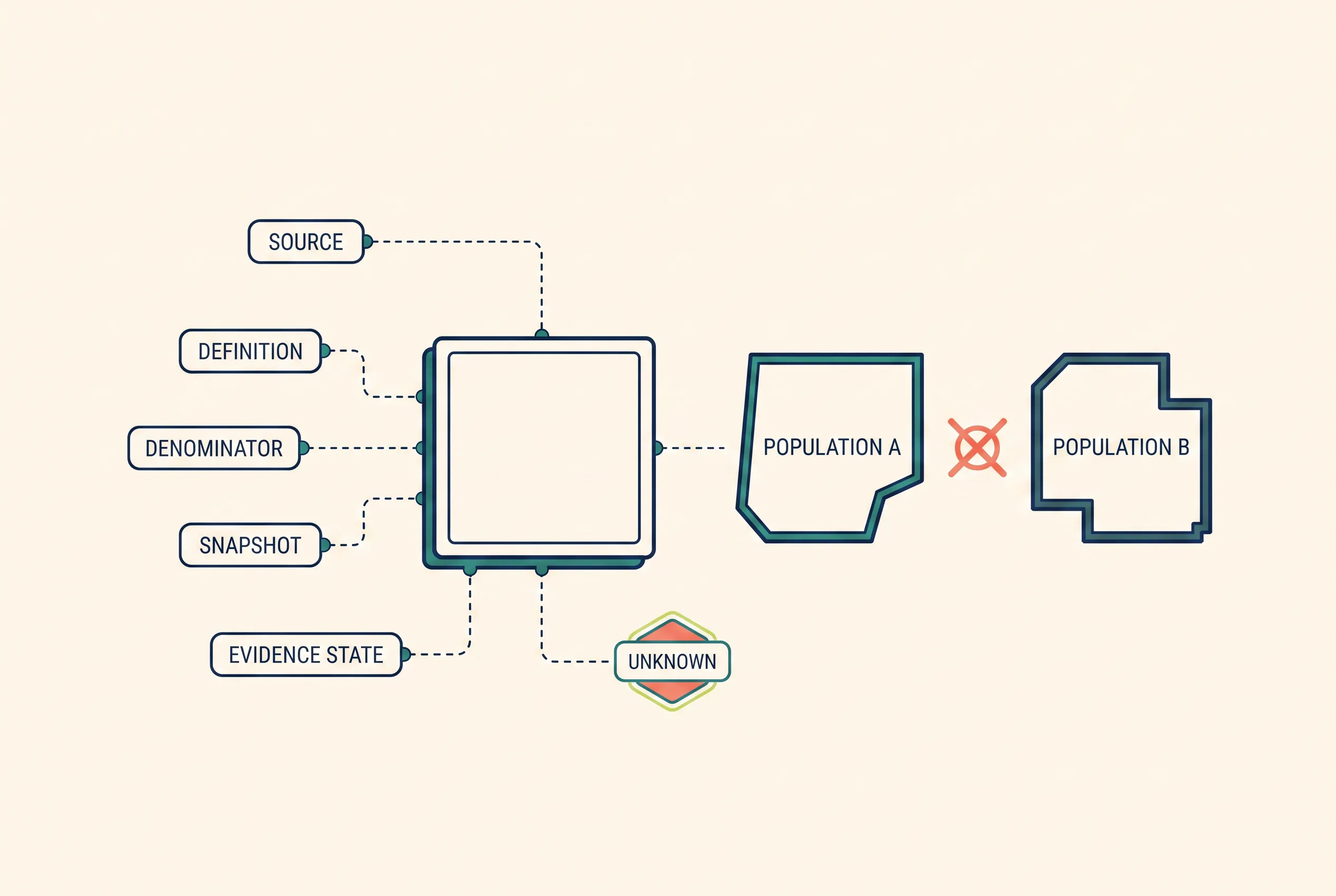
3. **How the value was produced and what remains unknown.** Ask the vendor to explain whether a value was observed from a source or derived through a documented method, and separately ask how it treats unknown values. Do not present a derived grouping as a raw source fact, and do not convert a missing source signal into a negative finding. DentalCensus publicly describes observed signals, derived intelligence, and its “unknown is not no” handling in its methodology and [coverage reporting](/reports/national-coverage).
Ask how a value was produced and what remains unknown.
4. **Denominator and population.** Any coverage or prevalence statistic needs its denominator. A clinic-profile count and a website-analysis count answer different questions and are not interchangeable populations.
5. **Freshness and version.** Request the version or snapshot date for the fields and export you plan to use. DentalCensus describes collection as rolling and incremental, with dated historical snapshots retained rather than silently rewritten; its public methodology does not establish a universal field-level service-level agreement.
6. **Permitted use and delivery.** Obtain written terms covering permitted use, export, redistribution, retention, and source attribution for the workflow you intend to run. Public methodology and public-source availability do not establish those rights.
## How to read DentalCensus public coverage
DentalCensus’s public July 2026 coverage report describes a clinic-profile universe of 103,674 US dental clinics, 723 metro markets, and approximately 107K regions. It labels these as aggregate research claims, not a public clinic directory; they are snapshot-specific figures, not a completeness claim or an export entitlement. Review the underlying [national coverage report](/reports/national-coverage).
For website-derived service, technology, and marketing fields, interpret a flag as evidence that a clinic source exposed that attribute during collection. Its absence is not evidence that the clinic lacks the attribute. The signal does not by itself verify ownership; buyers should validate questions about installed technology, clinical capability, ownership, or buying intent with appropriate additional evidence.
## How CMS NPPES fits—and where it stops
Public provider files require buyer-specific matching and interpretation.
CMS describes NPPES downloadable data as FOIA-disclosable health-care-provider data. Buyers still need to assess whether provider-level records fit the practice-level use and matching context of their intended decision. [CMS Data Dissemination](https://www.cms.gov/medicare/regulations-guidance/administrative-simplification/data-dissemination)
CMS provides a daily query registry plus monthly replacement, weekly incremental, and deactivation files. For maintenance, CMS says weekly incremental files supplement the full monthly replacement file; users need the monthly file to keep their systems current. That describes CMS’s file-maintenance approach, not the freshness of a third-party dataset derived from NPPES. [CMS NPI Files](https://download.cms.gov/nppes/NPI_Files.html)
NPPES values are reported by a provider, representative, or an organization provider’s authorized official, and blank file elements are represented as empty values. Preserve the source and missingness rather than infer an unreported attribute. [CMS Data Dissemination](https://www.cms.gov/medicare/regulations-guidance/administrative-simplification/data-dissemination)
An NPI is not evidence that a provider is licensed or credentialed: CMS explicitly says issuance does not ensure or validate either status. Appropriate authoritative verification is required for those questions. [CMS NPI Files](https://download.cms.gov/nppes/NPI_Files.html)
## A practical purchase test
Choose a small, representative sample of the accounts, markets, or locations behind your decision. For each decision-relevant field, ask: What is the entity? What location does it represent? What is the source? When was it observed? Was it observed or derived? What remains unknown? What denominator applies? Is the field included in my export? May I use and retain it for this workflow?
If a vendor cannot answer one of those questions, record that element as unknown rather than filling the gap with an assumption. The public sources reviewed do not establish a complete DentalCensus field-level schema, customer export schema, customer-specific license, completeness of all US dental practices, credentialing, installed technology, verified ownership, buying intent, NPPES-to-clinic matching method, matching error rate, or plan-specific field availability.
## Sources
- Our Data & Methodology — DentalCensus — https://dentalcensus.com/data (DentalCensus)
- National Dental Market Coverage — DentalCensus — https://dentalcensus.com/reports/national-coverage (DentalCensus)
- NPI Files — https://download.cms.gov/nppes/NPI_Files.html (Centers for Medicare & Medicaid Services)
- Data Dissemination — https://www.cms.gov/medicare/regulations-guidance/administrative-simplification/data-dissemination (Centers for Medicare & Medicaid Services)
---
# How to Evaluate a DentalCensus Market View
URL: https://dentalcensus.com/insights/how-to-evaluate-a-dentalcensus-market-view
Author: DentalCensus Research
Published: 2026-08-27 · Updated: 2026-08-27 · Source cutoff: 2026-08-27
Audience: Commercial leaders at dental manufacturers, distributors, dental SaaS companies, agencies, and DSO growth teams
Evidence status: reviewed
## Short answer
What makes a dental market view decision-ready?
A dental market view is ready for commercial screening only when observed, derived, and unknown evidence remain separate and each material metric includes its source, definition, denominator, snapshot date, and evidence state. It should prioritize the next validation step, not promise an outcome.
## Article
For commercial leaders at dental manufacturers, distributors, dental SaaS companies, agencies, and DSO growth teams, a market view is useful only when its limits are as clear as its signals. Before using a territory, market, or account view to prioritize work, ask: what did a source show, what did analysis derive, and what remains unknown?
DentalCensus describes itself as a market-intelligence layer built from public evidence, normalized entities, dated historical signals, and cross-segment analysis. That is DentalCensus’s description of its methodology and product model, not an independent audit of its implementation or quality. Its public methodology also describes a distinction between source observations, derived intelligence, and unknown values.
A polished directory or survey can still be useful for finding a starting point. But a commercial decision needs source, definition, denominator, snapshot, and uncertainty context to judge whether a signal is comparable and ready for validation.
## Keep three evidence states separate
**Observed** means a source or public page showed a signal at the relevant snapshot. Preserve the source, definition, and time context. A website-derived detection supports the narrower statement that a clinic source exposed an attribute during collection. It does not prove that the attribute is absent when no website signal was observed.
**Derived** means available inputs were normalized, combined, compared, or otherwise analyzed. Derived views can make evidence easier to review for research prioritization, but they remain dependent on input coverage, definitions, and method.
**Unknown** means the available evidence does not support a conclusion. It is not a negative finding, a complete-market claim, or a legal conclusion. It identifies where validation is still needed.
DentalCensus says its outputs are intended to retain source, dated snapshot, status, and field-definition context, while keeping missingness explicit. Inspect that context on the particular output being used. A public methodology statement does not establish that every individual record is complete or current.
## Apply the standard to commercial choices
For territory planning, start with a bounded screening question: which markets merit deeper practice-level research? A comparison can help order the next investigations, but it does not itself prove qualified demand, buying authority, conversion, or revenue. Record the population, date, inputs, and next validation step.
For account prioritization, treat a public digital or business signal as a reason to investigate fit, not proof of operational need, buying authority, or a missing capability. If a material signal is unavailable, mark it unknown and determine whether approved research or sales validation is warranted.
For partnership or network research, separate a source-backed market-structure signal from a conclusive ownership or control finding. DentalCensus describes DSO affiliation and organization groupings as available-evidence signals and derived groupings, rather than legally verified ownership determinations. Legal ownership, control, and valuation require separate diligence.
For contact research, a public professional contact signal can help identify a possible path for validation. DentalCensus says coverage varies by account and source, and that unobserved information remains unknown. A missing contact is not proof that no relevant contact exists; a listed contact is not, by itself, proof that the person is the current decision-maker.
## Require context with every material metric
Every material count, percentage, or segment statement needs five fields:
- Source and direct destination
- Definition
- Denominator or population
- Snapshot date
- Evidence state: observed, derived, or unknown
A material metric is decision-ready only when its source, definition, denominator, snapshot and evidence state travel with it.
DentalCensus describes collection as rolling and incremental and presents public figures as dated snapshots with retained history. Interpret a value as time-bound, then check freshness on the specific output before making a decision. Do not compare percentages from different populations as though they share a denominator: DentalCensus says clinic-profile counts and website-derived detections use different denominators.
A changed count may reflect a changed denominator, additional collection, a revised definition, or an underlying change. Without enough context to distinguish those explanations, the display is not evidence of a trend.
## Make validation part of the output
A concise review sequence is enough:
1. State the commercial decision and intended revenue path.
2. Label each material input observed, derived, or unknown.
3. Attach source, definition, population, and time context.
4. Identify the smallest validation step needed before action.
5. Record what evidence would change the priority and which guardrail would stop the action.
This approach keeps research useful while preserving its limits. A territory may be prioritized for review without being called a guaranteed opportunity. An account may be queued for validation without being described as a verified fit.
DentalCensus’s public [National Dental Market Coverage](/reports/national-coverage) page identifies a July 2026 aggregate snapshot of 103,674 clinic profiles and 723 metro markets. Those are DentalCensus-published aggregate research figures, not an independently verified count of all US dental clinics or a public clinic directory. The current provenance, definition, freshness, and completeness of any specific market, account, contact, or signal should be checked in its dated output.
Review the available [source and methodology context](/data) before relying on a market view for a commercial decision.
## Sources
- DentalCensus data and methodology — https://dentalcensus.com/data
- National Dental Market Coverage — https://dentalcensus.com/reports/national-coverage
- Market Structure & DSO Intelligence — https://dentalcensus.com/capabilities/market-structure-dso
- Contact & Decision-Maker Intelligence — https://dentalcensus.com/capabilities/contact-decision-maker-intelligence