How Dental Labs Can Qualify Service-Fit Accounts Before Outreach
A source-aware playbook for building a route-practical clinic shortlist without inferring volume, lab relationships, dissatisfaction, or switching intent.

Short answer
How can a dental lab qualify service-fit accounts before outreach?
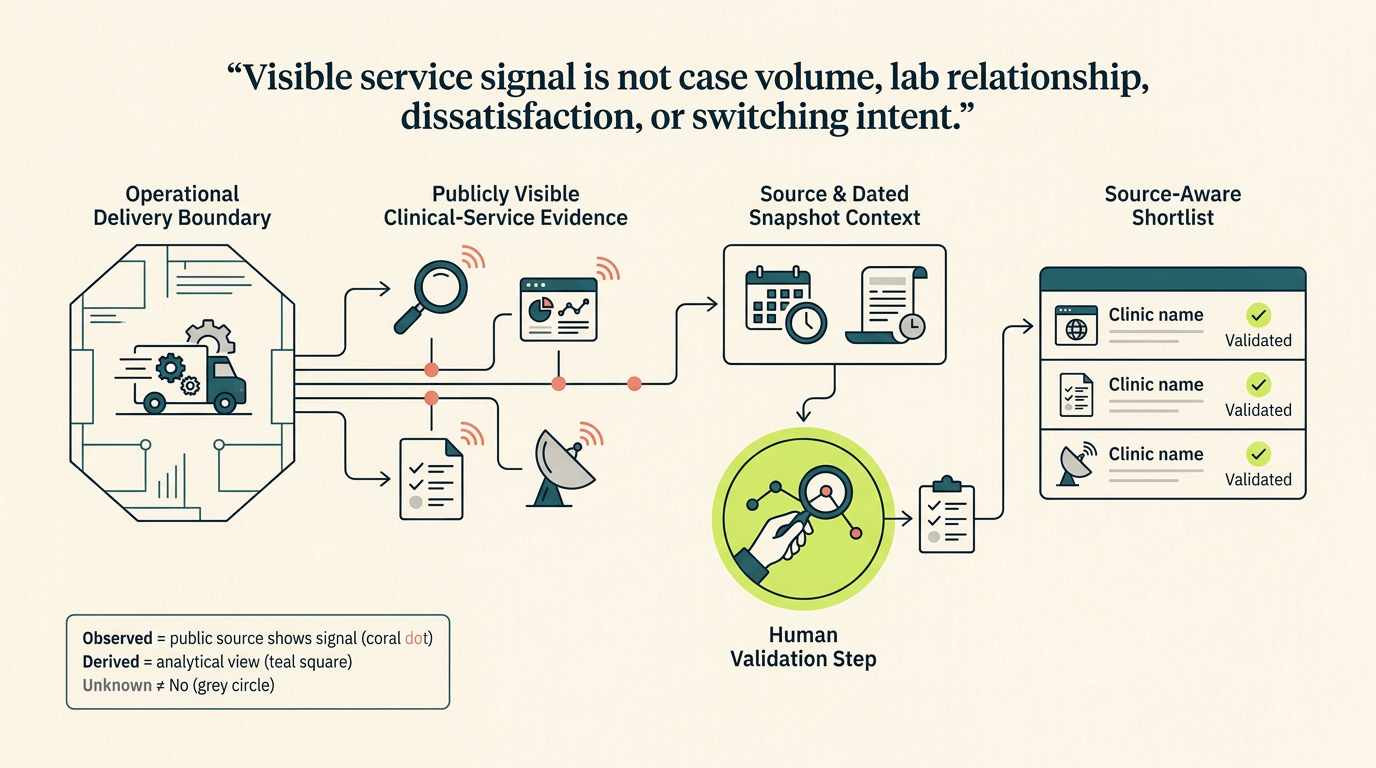
Define an operational delivery boundary, screen for publicly visible service evidence, preserve source, freshness, confidence, and unknown states, review network context without treating it as legal ownership, and complete human validation before outreach. The resulting shortlist prioritizes investigation; it does not prove case volume, lab relationship, dissatisfaction, switching intent, or revenue.
Dental lab owners and business-development teams: use this playbook to replace an undifferentiated dentist list with a shortlist that a rep can inspect and validate before outreach.
Start with the route you can actually serve
Set the first boundary from courier reality and rep capacity—not from a broad city or regional label. Record the boundary as an operating assumption: it is a way to focus research, not evidence that a radius will create demand or revenue. DentalCensus presents this as an illustrative workflow for defining a delivery boundary before account review.
Screen for visible service fit
Within that boundary, retain clinics with publicly visible clinical-service signals that match the case types your lab wants to pursue. Treat each signal as website-derived evidence: it means the clinic publicly presents the service, not that it performs a given volume, sends cases to a lab, or will fit after local review. DentalCensus clinical-services guidance describes service mix as a starting point for territory planning and prioritization.
For every retained account, preserve the field state:
- Observed: a public source shows the signal, with source and snapshot context.
- Derived: an analytical view combines available dimensions.
- Unknown: the public evidence was not observable or analysis was incomplete.
Unknown is not “no.” That distinction matters for services, contacts, and network fields. DentalCensus’s data methodology also notes that collection is rolling and incremental, dated snapshots are retained, and a snapshot should not be silently rewritten as a current fact.
Make freshness and structure visible
Attach the source, observation or snapshot context, freshness, and confidence to each qualification field. This tells a rep what requires a local recheck before a visit or message.
Review network relationships as account-research context. A verified or derived relationship can indicate that locations merit a shared-account review, but it is not legal ownership proof. Likewise, “no links found” and “not analyzed yet” are different states. DentalCensus network-detection methodology explains its provenance labels and these limits.
Require a human validation pass
Before outreach or a field visit, have a person check four things:
- Delivery fit for the actual route.
- The visible-service rationale and its freshness.
- Whether account structure calls for a shared-account review.
- The most relevant publicly supported role or contact path.
This is the point where local knowledge, a visit, and a price conversation can inform the account decision. The illustrative lab-territory workflow is explicit that visible services are not case counts and do not establish lab relationship, delivery fit, dissatisfaction, or willingness to switch.
Use discussion posts only to improve questions
Public lab-sales discussions can suggest questions for the validation pass—for example, whether a visit is welcome and who should receive it. They are not representative evidence that dentists generally want to switch labs or that a tactic will work. See the anecdotal discussions in r/Dentistry and r/dentallab.
The practical output
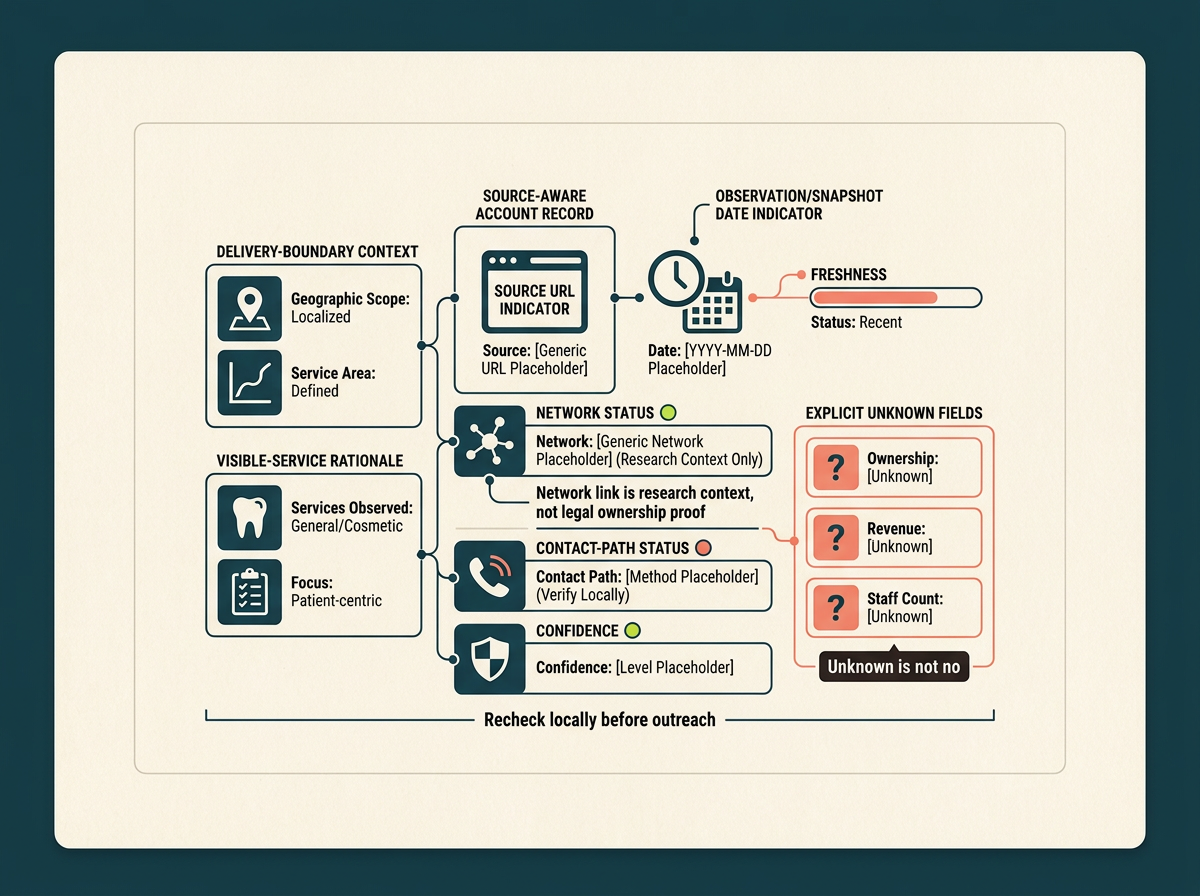
Your shortlist should show: delivery-boundary context, visible-service rationale, source and freshness, network status, contact-path status, confidence, and explicit unknowns. It prioritizes where to investigate. It does not demonstrate case volume, incumbent lab relationship, dissatisfaction, switching intent, or revenue.
For the fields and evidence semantics behind this workflow, evaluate the DentalCensus dental-lab solution.
Evidence and limits
Sources used for this article
This article uses DentalCensus methodology and illustrative workflow pages, plus anecdotal public discussion only as qualitative question evidence. Source cutoff: September 16, 2026.
Methodology: Public-source research with claim-level source IDs; independent fact/evidence and editorial/visual verification. Unknowns remain explicit.
Limits and caveats
- No public source reviewed establishes a specific lab's delivery radius, capacity, desired case mix, pricing, turnaround, or rep coverage; these must be supplied by the lab.
- No reviewed source establishes case volume, current lab relationship, dissatisfaction, willingness to switch, or revenue for any individual practice.
- No exact displayed publication or revision date was found for the reviewed DentalCensus pages; their embedded snapshot dates are not page publication dates.
- The reviewed Reddit pages show relative posting times, not an exact publication date, and do not provide representative evidence of dentist or lab-market behavior.
- No individual clinic, contact, ownership relationship, office count, or route was researched for this brief.
- A later local check is needed for any account field older than its stated snapshot or observation date.
- Dental Lab Prospecting Data — DentalCensus ↗
src_dc_lab_solution · DentalCensus · Accessed 2026-09-16
The page describes lab territory uses including filtering implant, all-on-X and cosmetic practices near a lab, region-level exports, and service/ownership context. It states that website-derived flags mean a clinic says so on its website; derived views combine dimensions; and unknown remains distinct from no. Its bounded Denver example says literal name matches are only seeds for manual local-account review and must not be taken as verification of services, case volume, lab relationship, or delivery fit. The displayed export date is July 11, 2026, while field-observation timestamps are unavailable.
- Clinical services — DentalCensus ↗
src_dc_clinical_services · DentalCensus · Accessed 2026-09-16
The page describes website-derived signals for implants, all-on-X/full-arch, Invisalign, pediatric, orthodontics, oral surgery, and sedation. It says unknown means the source did not provide an observable signal and is not treated as no. It presents service mix as a starting point for territory planning and account prioritization, and labels public figures as dated, source-aware snapshots.
- Our Data & Methodology — DentalCensus ↗
src_dc_data_methodology · DentalCensus · Accessed 2026-09-16
The methodology page distinguishes observed signals (what a public source shows with source and snapshot context) from derived intelligence (normalized entities, historical change, and intersections). It says collection is rolling and incremental, snapshots are dated, and history is retained. It also says missing evidence stays unknown; website-derived flags mean a clinic says so on its website rather than verified ownership; and a dated snapshot is not silently rewritten as a current fact.
- Network Detection Methodology — DentalCensus ↗
src_dc_network_methodology · DentalCensus · Accessed 2026-09-16
The page says network relationships are derived from shared contact infrastructure, web/media assets, and practitioners, then independently verified; it labels detection provenance as inferred, extracted, or observed. It says a confirmed link is not a legal ownership registry and does not replace research. For a record covered by a snapshot, no links found differs from not analyzed yet for newer records; unknown is not converted into a negative finding. Displayed figures are for the August 2026 snapshot and the page says the graph refreshes monthly.
- How a dental lab decides which practices are worth a visit this quarter — DentalCensus ↗
src_dc_lab_territory · DentalCensus · Accessed 2026-09-16
This page is explicitly labeled an illustrative workflow, not a customer story, measured result, or forecast. It frames the sequence as: set a delivery boundary from courier reality and rep capacity; retain practices with visible services matching the desired case mix; handle shared-owner groupings as derived until confirmed; and check a public role/contact path and when it was last seen. It says a visible service signal is not a case count or proof that the practice sends any cases; it says nothing about dissatisfaction or switching willingness. It describes account fields for fit rationale, territory context, network relationship, decision-maker path, source, freshness, and confidence, and says local knowledge, a visit, and a price conversation still decide the account.
- Dental lab sales position : r/Dentistry ↗
src_reddit_dentistry_sales · Reddit · Accessed 2026-09-16
A post asks dentists how willing they are to try new labs. Comments describe individual experiences with uninvited lab-rep visits and preference not to interrupt patient care. The page displays relative times rather than an exact publication date. This is anecdotal discussion, not representative evidence of dentist preferences or switching behavior.
- Inquiries : r/dentallab ↗
src_reddit_dentallab_inquiries · Reddit · Accessed 2026-09-16
A dental-lab owner asks how to find offices and prompt them to send work. Replies offer individual tactics, including introductions and finding an approach suited to each account. The page displays relative times rather than an exact publication date. This is qualitative, self-reported discussion only; it does not establish effectiveness, demand, or prospect intent.
Continue the research