Record Count Is Not Market Coverage: How to Read a Dental Data Claim
Compare dental coverage claims by defining what each record count actually represents.

Short answer
What does a dental database coverage number actually measure?
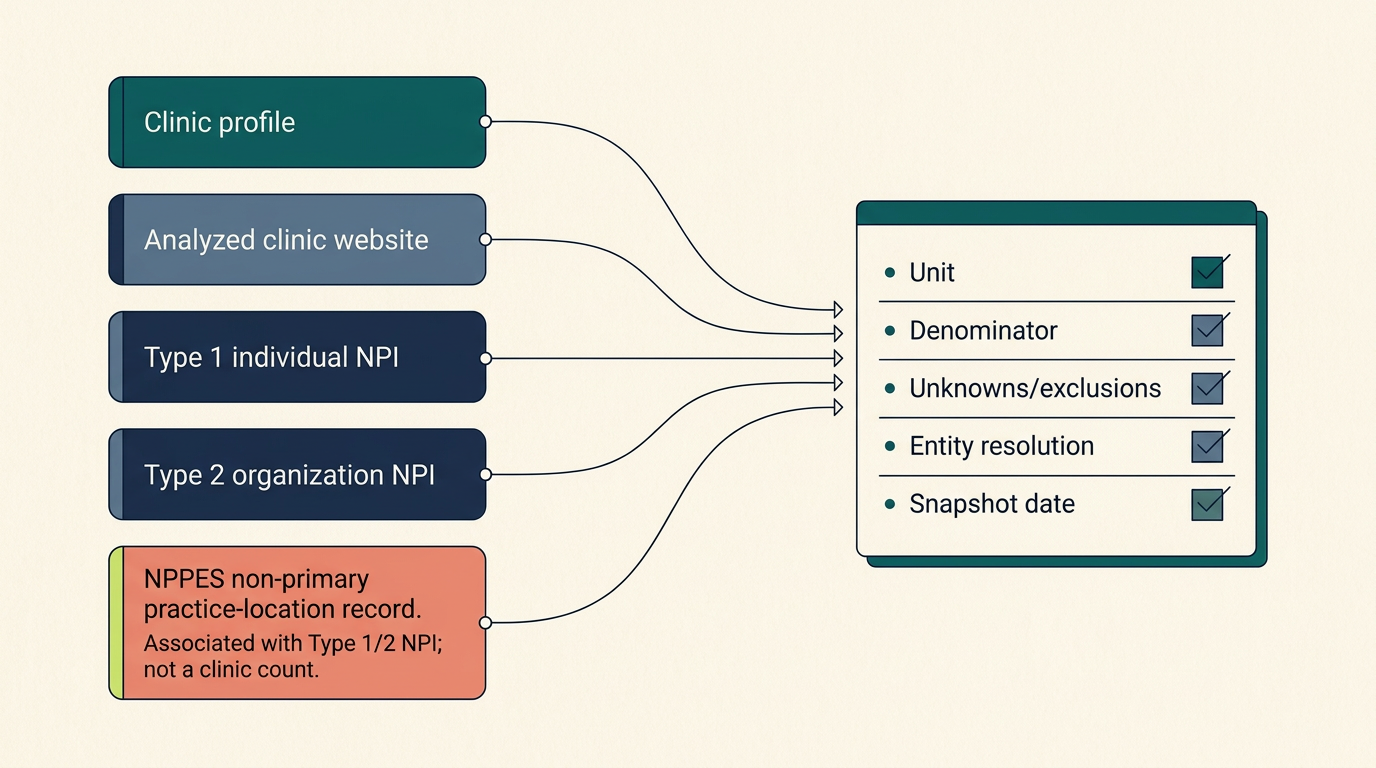
It measures only the population defined by the claim. To compare dental data coverage responsibly, identify the unit counted, denominator, exclusions and unknown treatment, duplicate or entity-resolution rules, and snapshot date. DentalCensus describes a July 2026 clinic-profile figure of 103,674, while some modules describe approximately 101,000 analyzed clinic websites; NPI records are identifiers, not inherently clinic counts.
If you buy dental data or research dental businesses, start with a simple question: what does each record represent? A list of websites, a list of dentists and a list of clinic locations can all have large totals. Those totals do not tell you the same thing.
To judge market coverage, you need to know both what was counted and which part of the market the count describes.
The five questions behind every coverage claim
- What is being counted? A person, a business, a clinic location and a website are different things.
- What group is the number based on? This is the denominator. For a percentage, it is the total used in the calculation.
- What is missing? If a clinic website does not mention a service, that alone does not prove the clinic lacks it.
- How are repeated and related records handled? Ask how the supplier identifies duplicates and connects records belonging to the same clinic or group. This process is often called entity resolution.
- When was the information collected? A snapshot describes a particular time. It should not be presented as an undated fact about today’s market.
DentalCensus’s data methodology explains its treatment of sources, dates, missing information and results produced by analysis. These are descriptions of its method, not proof that every record is complete.
What DentalCensus publicly describes
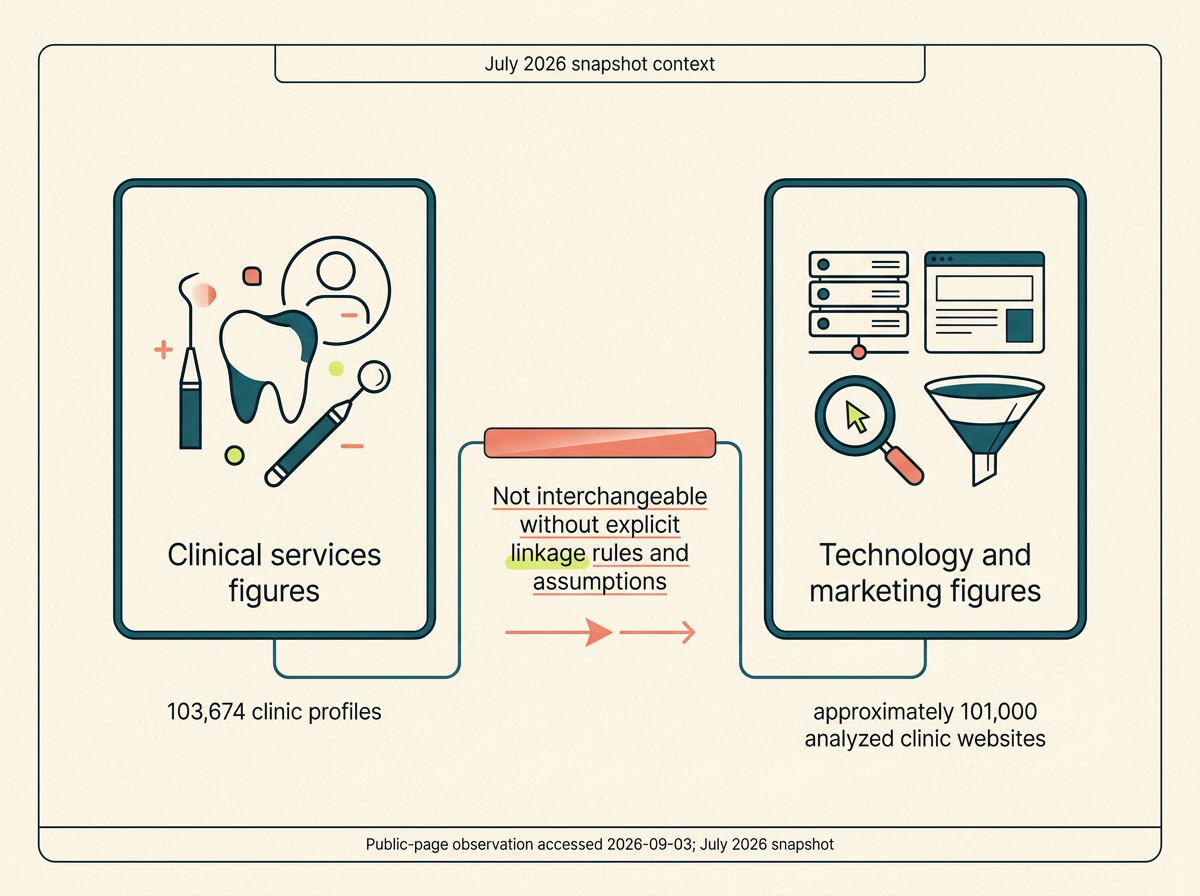
The national coverage report describes 103,674 US clinic profiles in a July 2026 snapshot. It presents an aggregate research count, not a public clinic directory or a claim to include every US dental clinic.
The report also uses different totals for different questions. Clinical-services figures use 103,674 clinic profiles. Technology and marketing figures use about 101,000 analyzed clinic websites. A percentage based on those websites cannot automatically be treated as a percentage of all clinic profiles.
Here is an illustrative example, not DentalCensus data. Suppose you review 100 clinic websites and 20 mention a service. That is 20% of the websites reviewed. It does not show that 20% of every clinic in the area offers the service. Silence on the remaining 80 websites does not prove that the service is absent.
DentalCensus distinguishes information shown by a source from results produced by analysis. For example, a website statement is an observation; a grouping assembled from several records is a derived result. The methodology page says missing evidence remains unknown.
Why NPI records are not clinic counts
The Centers for Medicare & Medicaid Services (CMS) describes the National Provider Identifier (NPI) as an identifier for covered health care providers. Counting those identifiers is not the same as counting dental clinics. See the CMS NPI explanation.
The CMS fact sheet separates two types:
- Type 1 identifies an individual provider. An individual is eligible for one NPI.
- Type 2 identifies an organization. An organization can have multiple NPIs.
A provider who operates through a corporation can have a personal Type 1 NPI and a Type 2 NPI for the company. Adding these records together can therefore mix people and organizations rather than count clinics.
The National Plan and Provider Enumeration System (NPPES) stores these identifiers. Its Practice Location Reference File lists additional, non-primary practice locations associated with Type 1 and Type 2 NPIs. The cited CMS page does not present that file as a complete count of unique dental clinics or locations.
CMS also warns that receiving an NPI does not verify a provider’s license or credentials. An NPI alone does not establish that a dental clinic is operating today.
A disciplined comparison
Before choosing a data supplier, ask for a short explanation of the count: what it includes, what it excludes, how duplicates are handled and which date it describes.
If two suppliers count different things, compare the definitions before comparing the totals. The sources below do not provide a universal dental-market total or a reliable conversion from websites, provider identifiers or associated location records into unique clinic counts.
Sources
The original research accessed these sources on September 3, 2026. DentalCensus’s figures describe July 2026.
Evidence and limits
Sources used for this article
The cited public sources were accessed on 2026-09-03, the stated America/Los_Angeles cutoff date; the DentalCensus figures describe a July 2026 snapshot. Source cutoff: September 3, 2026.
Methodology: Public-source research with claim-level source IDs; independent fact/evidence and editorial/visual verification. Unknowns remain explicit.
Limits and caveats
- No inspected public source defines a complete national universe of US dental clinics against which DentalCensus’s 103,674 clinic-profile snapshot can be divided to calculate a universe-completeness percentage.
- The inspected public DentalCensus pages do not publish row-level clinic inclusion/exclusion rules, duplicate-rate statistics, a reconciliation table to NPPES, or a record-level cutoff timestamp.
- The inspected CMS sources do not provide a dental-only, deduplicated clinic denominator or state that NPPES NPI records constitute a national clinic or location universe.
- The public sources do not provide a defensible conversion factor from NPI records, Type 2 organization records, or NPI-associated practice-location records to unique dental clinics.
- The brief’s cutoff is 2026-09-03 America/Los_Angeles. The DentalCensus public snapshot is July 2026; the CMS NPPES page listed an August 10, 2026 monthly file and weekly updates through August 30, 2026. No claim here treats either source as a synchronized record-level snapshot at the cutoff.
- National Dental Market Coverage — DentalCensus ↗
src_dc_national_coverage · DentalCensus · Accessed 2026-09-03
The page identifies itself as “Research / national coverage / July 2026.” It reports 103,674 “US dental clinics in the clinic profile universe,” sourced to a DentalCensus clinic-profile snapshot, and says counts are aggregate research claims rather than a public clinic directory. It states that clinical-services figures use N=103,674 clinic profiles, while technology and marketing figures use about 101,000 analyzed clinic websites; those denominators are not interchangeable. It also says collection is rolling and incremental, the published figures describe the July 2026 snapshot, organization grouping is derived, and a missing website-source signal is unknown rather than a negative finding.
- Our Data & Methodology — DentalCensus ↗
src_dc_data_methodology · DentalCensus · Accessed 2026-09-03
The page reports 103,674 US dental clinics tracked and 101,000 clinic websites analyzed, with July 2026 snapshot context and rolling, incremental collection. It describes a process that resolves entities, keeps definitions, missingness and provenance explicit, and retains dated snapshots. Its output contract includes source, snapshot, status (observed, derived, unknown), and denominator/field definition. It says unknown is not counted as no, every percentage states its denominator, website-derived flags describe what a clinic says on its site rather than verified ownership, and published reports include source, snapshot date, N, and metric definitions.
- National Provider Identifier Standard (NPI) ↗
src_cms_npi_standard · Centers for Medicare & Medicaid Services · Accessed 2026-09-03
CMS describes the NPI as a unique 10-digit, intelligence-free identifier for covered health care providers, used in HIPAA administrative and financial transactions. CMS states that the number itself does not carry provider information such as state or medical specialty.
- The National Provider Identifier (NPI) Fact Sheet ↗
src_cms_npi_fact_sheet · Centers for Medicare & Medicaid Services · Accessed 2026-09-03
CMS states that NPPES assigns and stores/manages NPIs. Type 1 NPIs are for individual health care providers, who are eligible for one NPI; Type 2 NPIs are for health care organizations, which can have multiple NPIs. CMS gives the example that an incorporated provider can obtain a Type 1 NPI personally and a Type 2 NPI for the corporation or LLC. CMS also says an NPI does not ensure licensure or credentialing.
- NPI Files ↗
src_cms_nppes_files · Centers for Medicare & Medicaid Services · Accessed 2026-09-03
CMS’s NPPES download page says each downloadable file includes an Other Name reference file for Type 2 NPIs and a Practice Location reference file containing non-primary practice locations associated with Type 1 and Type 2 NPIs. At the cutoff, the page listed a Version 2 monthly dissemination file dated August 10, 2026 and weekly incremental files through the August 24–30, 2026 period. CMS also states that issuance of an NPI does not ensure or validate licensure or credentialing.
Continue the research