What Can Public Ad Observations Show About Dental Clinics?
Use public ad observations to prioritize research—without treating them as evidence of spend, targeting, performance, or intent.

Short answer
Can public signals show which dental clinics are running ads?
Public Google and Meta ad-library findings can support narrow, source-bounded observations about ads returned or displayed in a documented search context. A Google result may concern a selected historical period, while Meta documents ads listed as currently running. Preserve the platform, observed identity, date or period, source link, and identity caveat before using a signal to prioritize research. These observations do not establish clinic identity, spend, ROI, budget, agency relationships, targeting beyond visible fields, or commercial intent. A missing result remains unknown, not proof that a clinic has no ads.
If you work at a dental marketing agency or sell software to dental businesses, public ad libraries can give you a starting point for research. They can show an ad and some details about it. They do not tell you whether a clinic needs your services or wants to change suppliers.
The useful question is: what did this source actually show, and when?
What a public ad result can support
Google’s Ads Transparency Center lets you search for advertisers and ads served on Google platforms. A result tells you what Google made available for that search, time period and set of filters.
Check the selected dates. The result may be historical, so it does not necessarily mean a clinic is running ads today. Finding a website name also does not, by itself, prove that it belongs to the clinic you are researching.
Meta’s Ad Library can show an ad listed as currently running across Meta technologies, along with its associated Page and visible details. That is an observation about the ad and Page. It does not prove who legally operates the clinic.
Keep platform observations distinct from classifications
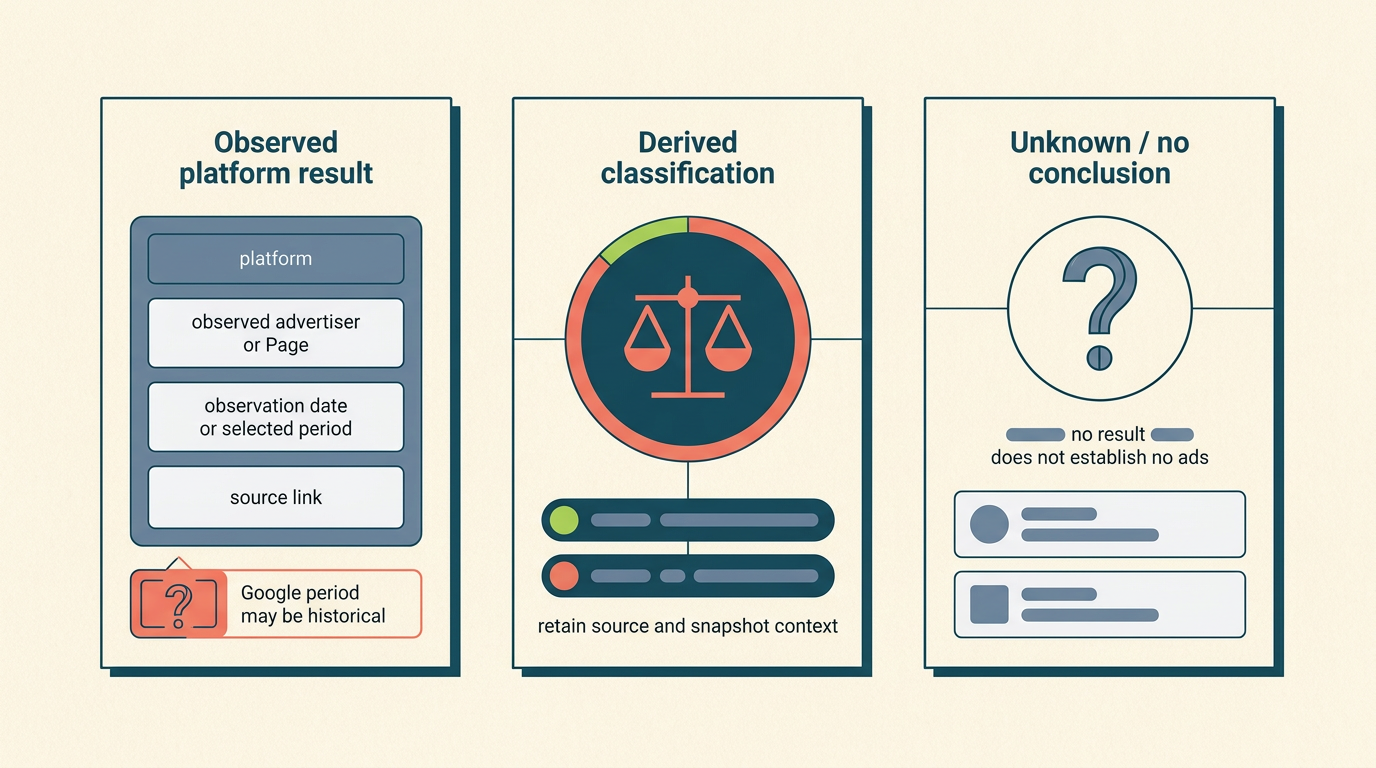
Separate what you saw from the conclusion you draw.
For example, in a hypothetical research note, “the library showed this ad for this Page on this date” records an observation. “This clinic is a good sales prospect” is a further judgment that needs more evidence.
DentalCensus’s methodology makes a similar distinction. An observed signal is something a source showed. A derived result is produced by combining or analyzing information. Its Google Ads or Meta Ads categories should not be read as a promise that every signal comes directly from a platform’s ad library.
For a useful research note, keep:
- The platform and direct source link.
- The advertiser or Page name exactly as shown.
- The date you looked and any selected date range.
- Any uncertainty about matching the result to a clinic.
Those details can support further research. They do not establish that an account is a good fit or intends to buy.
What not to infer
An ad’s presence does not reveal its budget, return on investment, results or relationship with an agency. Do not assume you know the advertiser’s targeting beyond the fields actually displayed.
Meta makes some information available only for particular ad types or regions. Its documentation describes spending, impression and audience-demographic fields for specified social-issue, election or political ads. It separately describes transparency information for ads targeting people in the UK or EU. See Meta’s transparency update.
Use only the information visible for the particular ad and applicable region. Do not assume those fields are available for an ordinary commercial ad. These limits describe public information, not what an advertiser might see in private tools.
DentalCensus’s marketing-signals page likewise says its public signals are not claims about ad spending or performance. They describe dated observations.
Absence is unknown
A search that returns no ads does not prove a clinic is not advertising. The result may depend on the name searched, the source, the date range or the records collected. DentalCensus’s methodology treats missing evidence as unknown.
No named clinic, advertiser, Page or dated ad result was supplied for this article. It therefore does not establish whether any particular clinic is running ads.
Use a public result to choose the next question to research. Before drawing a business conclusion, check the identity, dates and missing information.
Explore marketing and demand signals for more about interpreting these observations.
Evidence and limits
Sources used for this article
This article uses official Google and Meta documentation alongside DentalCensus methodology to distinguish source-bounded observations, derived views, and unknowns. Source cutoff: September 11, 2026.
Methodology: Public-source research with claim-level source IDs; independent fact/evidence and editorial/visual verification. Unknowns remain explicit.
Limits and caveats
- Whether any named dental clinic is currently running ads: no clinic, advertiser identity, Page identity, search result, or observation timestamp was supplied.
- Whether a public advertiser or Meta Page maps to a particular clinic or legal entity: this requires separate identity evidence.
- Advertising spend, budget, targeting, impressions, conversions, ROI, campaign objectives, and performance for ordinary dental commercial ads.
- Whether a clinic uses an agency, which agency it uses, whether it is dissatisfied, or whether it intends to switch agencies.
- Whether a clinic has no ads on Google or Meta: absence from a particular public search or collection result is unknown, not no.
- Completeness, latency, and historical-retention behavior of a specific platform result at the cutoff, beyond the platform documentation cited above.
- Ads transparency ↗
src_google_ads_transparency · Google · Accessed 2026-09-11
Google describes the Ads Transparency Center as a searchable repository of advertisers and ads served on Google platforms, including Search, Display, Gmail, and YouTube. Searches can use advertiser or website name and filters including date and targeted location. Google says the Center shows advertiser information and ads served over a time period; some additional fields, including targeting and recipient totals, are available only in certain countries or regions.
- Meta Ad Library API ↗
src_meta_ad_library_api · Meta · Accessed 2026-09-11
Meta states that the Ad Library should be used to search all ads currently running across Meta technologies. Its documentation identifies generally available ad fields as creative content, associated Page name and ID, delivery dates, and where the ad appeared. It limits spend, impressions, and demographic reach fields to social-issue, election, or political ads; it separately limits some data for UK/EU ads.
- New Features and Additional Transparency Measures as the Digital Services Act Comes Into Effect ↗
src_meta_eu_archive · Meta · Published 2023-08-24 · Accessed 2026-09-11
Meta says it expanded the Ad Library to display and archive all ads targeting people in the EU, with dates, targeting parameters, and delivery information, and that those ads are stored publicly for one year. This is a region-specific transparency statement, not evidence that equivalent historical fields are available for every non-EU commercial ad.
- Our Data & Methodology ↗
src_dentalcensus_methodology · DentalCensus · Accessed 2026-09-11
DentalCensus defines observed signals as what a source or public page actually shows with source and snapshot context, and derived intelligence as normalized entities, historical change, and intersections. It says its marketing-and-demand module includes Google Ads and Meta Ads; fields retain source, snapshot, status, and definition. It states that missing evidence remains unknown, derived groupings are labeled derived, dated snapshots are not silently rewritten as current facts, and detected attributes are tri-state: yes, no, or unknown.
- Marketing & demand signals ↗
src_dentalcensus_marketing_signals · DentalCensus · Accessed 2026-09-11
DentalCensus describes marketing activity as a public signal detected on a clinic website or related public source, including an advertising tag. It explicitly says this is not a claim about spend or performance and labels its public figures as dated, source-aware snapshots.
Continue the research